Live Forever
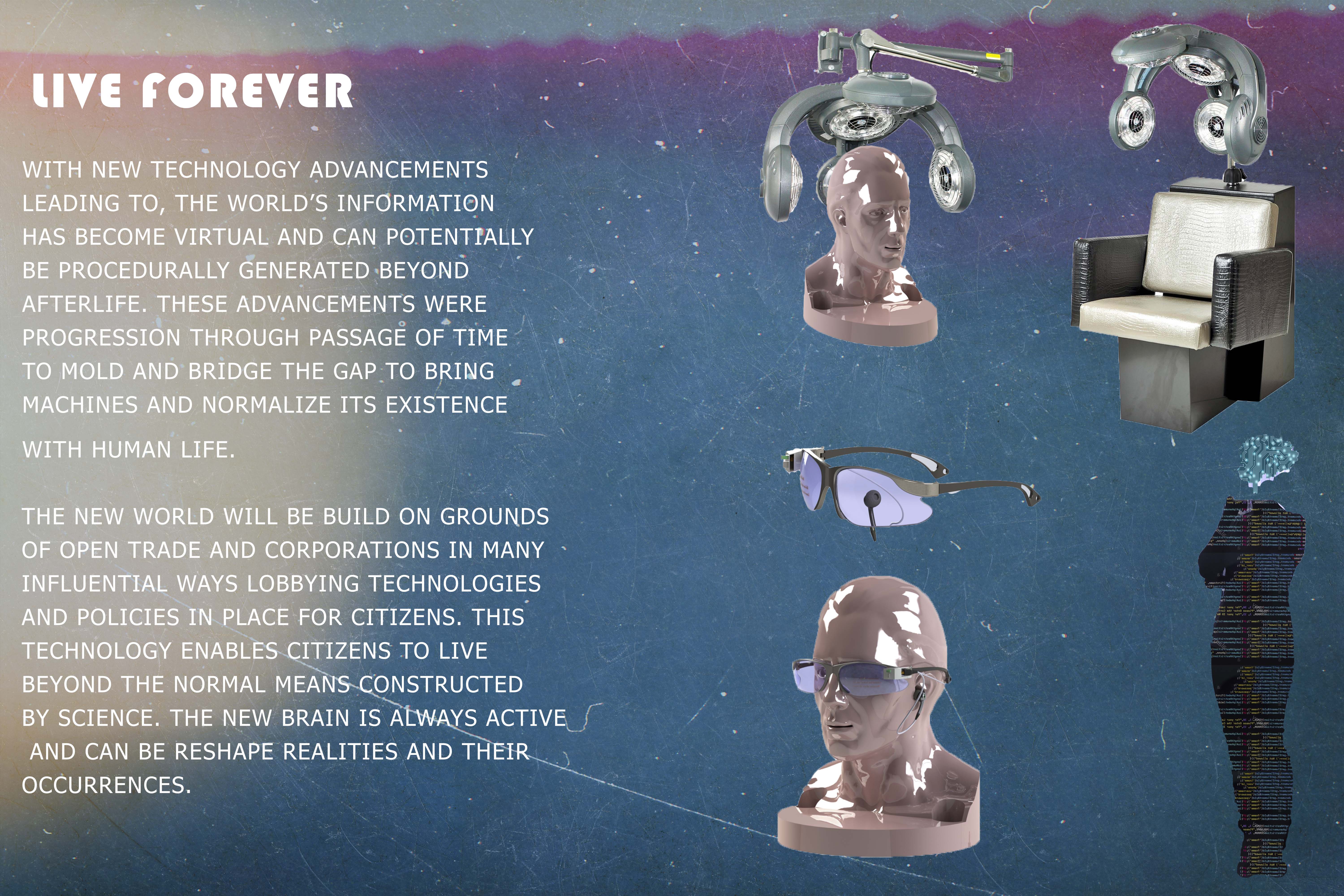
With new technology advancements leading to, the world’s information has become virtual and can potentially be procedurally generated beyond afterlife. These advancements were progression through passage of time to mold and bridge the gap to bring machines and normalize its existence with human life.
The new world will be build on grounds of open trade and corporations in many influential ways lobbying technologies and policies in place for citizens to live beyond the normal means constructed by science.
The new brain is always active and can be reshape realities and their occurrences.
With this new technology there are many companies that they save your memory and upload on their system.it means you will be made by codes. Their programmers would control your memory and upload them.
You should buy this kind of afterlife and also you can cancel this.Even after your death.
The question is when we can use this technology? you can go to these companies when you are young,then you can register and they download our memories then transfer them to their computer so when you die they use your brain for update your information .
If I wanna tell you about this after life the properties include:
This world is so fast which means you cant pay attention fully to your world because if you think about having something you would have it in one second, for example if you wanna take a taxi , the taxi is ready for you so no time’s gone to waste.
If you ask for help the employees in company can help you.remember you cant be connected to another people.
In this photo you can see the left photo is about a programmer who can communicate with them with this kind of technological eye glasses.
If I wanna tell you the benefits of this technology for companies I would say this companies could use your brain which means they can give the forever life to genius people and scientist.
Total recall
What if, rather than simply picking and choosing what we want to capture in digital form, it was possible to record the contents of a mind in their entirety? This work is neither science fiction nor the niche pursuit of unreasonably ambitious scientists. Theoretically, the process would require three key breakthroughs. Scientists must first discover how to preserve, non-destructively, someone's brain upon their death. Then the content of the preserved brain must be analysed and captured. Finally, that capture of the person’s mind must be recreated on a simulated human brain.
First, we must create an artificial human brain on which a back-up of a human’s memories would be able to ‘run’. Work in the area is widespread. MIT runs a course on the emergent science of ‘connectomics’, the work to create a comprehensive map of the connections in a human brain. The US Brain project is working to record brain activity from millions of neurons while the EU Brain project tries to build integrated models from this activity.
Anders Sandberg from the Future of Humanity Institute at Oxford University, who in 2008 wrote a paper titled Whole Brain Emulation: A Roadmap, describes these projects as “stepping stones” towards being able to fully able to emulate the human brain.
“The point of brain emulation is to recreate the function of the original brain: if ‘run’ it will be able to think and act as the original,” he says. Progress has been slow but steady. “We are now able to take small brain tissue samples and map them in 3D. These are at exquisite resolution, but the blocks are just a few microns across. We can run simulations of the size of a mouse brain on supercomputers – but we do not have the total connectivity yet. As methods improve I expect to see automatic conversion of scanned tissue into models that can be run. The different parts exist, but so far there is no pipeline from brains to emulations.”
Investment in the area appears to be forthcoming, however. Google is heavily invested in brain emulation. In December 2012 the company appointed Ray Kurzweil as its director of engineering on the Google Brain project, which aims to mimic aspects of the human brain. Kurzweil, a divisive figure, is something of a figurehead for a community of scientists who believe that it will be possible to create a digital back-up of a human brain within their lifetime
Memory dump
Emulating a human brain is one thing, but creating a digital record of a human’s memories is a different sort of challenge. Sandberg is cynical of whether this simplistic process is viable. “Memories are not neatly stored like files on a computer to create a searchable index,” he says. “Memory consists of networks of associations that are activated when we remember. A brain emulation would require a copy of them all.”
If it could be done, then, what would preserving a human mind mean for the way we live?
Some believe that there could be unanticipated benefits, some of which can make the act of merely extending a person’s life for posterity seem rather plain by comparison
digital back-up of a person’s mind could be studied, perhaps providing breakthroughs in understanding the way in which human beings think and remember.
And if a mind could be digitally stored while a person was still alive then, according to neuroscientist Andrew A Vladimirov, it might be possible to perform psychoanalysis using such data. “You could run specially crafted algorithms through your entire life sequence that will help you optimise behavioural strategies,” he says.
Yet there’s also an unusual set of moral and ethical implications to consider, many of which are only just beginning to be revealed. “In the early stages the main ethical issue is simply broken emulations: we might get entities that are suffering in our computers,”
The knowledge that one’s brain is to be recorded in its entirety might also lead some to behave differently during life. It would have the same effect as knowing your actions will be recorded on camera. In some people this knowledge leads to a tendency to conform to social norms. In others it produces rebelliousness. If one thinks that one will be recreated as a brain emulation then it is equivalent to expecting an extra, post-human life.
Even if it were possible to digitally record the contents and psychological contours of the human mind, there are undeniably deep and complicated implications. But beyond this, there is the question of whether this is something that any of us truly want. Humans long to preserve their memories (or, in some cases, to forget them) because they remind us of who we are. If our memories are lost we cease to know who we were, what we accomplished, what it all meant.