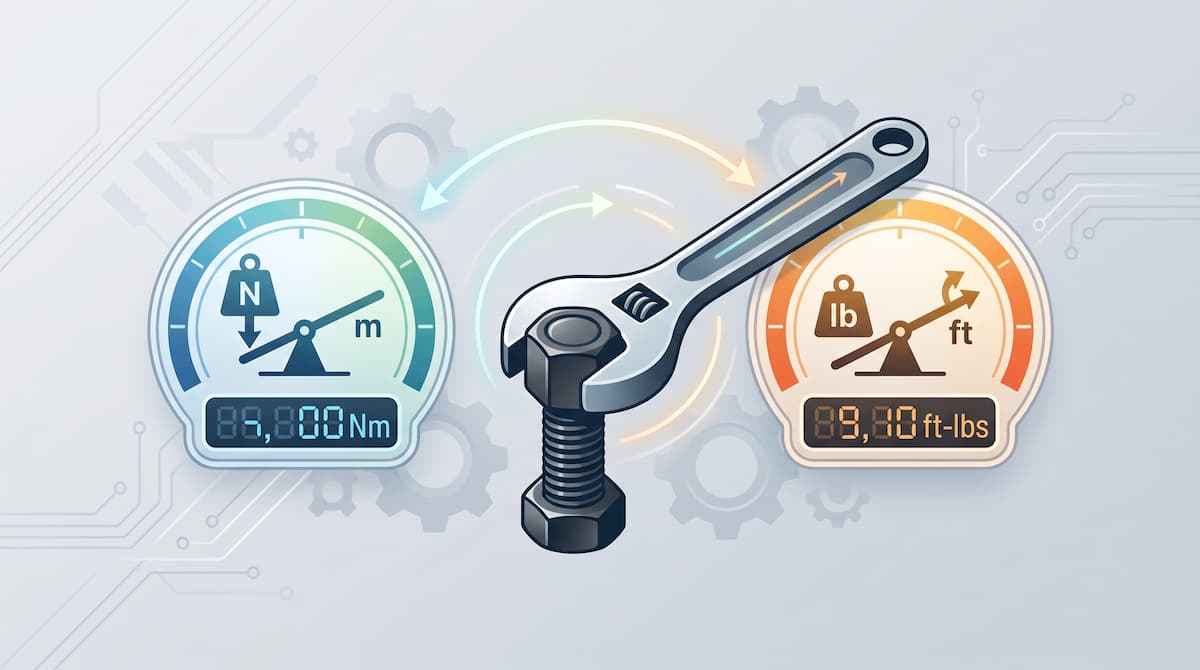
To convert Newton-meters to foot-pounds, multiply the metric torque value by 0.737562. Precision matters. When you apply rotational force to an engine block, using incorrect torque values can damage aluminum threads beyond repair.
This unit conversion is a daily necessity in modern mechanical workshops. Technicians frequently encounter imported machinery built to metric standards. Meanwhile, their existing garage tool kits often feature traditional imperial measurements.
Understanding how these two systems interact prevents costly mechanical failures. It also keeps assembly lines running safely.
To convert torque from Newton-meters (Nm) to foot-pounds (ft-lbs), multiply the Newton-meter value by 0.737562, or divide it by 1.355818. This mathematical relationship is derived from the scientific definitions of force and distance.
The primary mathematical formulas are:
ft-lbs = Nm × 0.737562
Nm = ft-lbs × 1.355818
Multiply by 0.73756. This is the standard multiplier.
For general shop calculations, some mechanics round the multiplier to 0.74. This approximation works well for non-critical fasteners like plastic trim brackets. However, internal engine components require the full six-decimal multiplier to avoid structural damage.
Imagine you are restoring a classic European motorcycle in a garage equipped with American hand tools. The service manual specifies every cylinder head fastener torque in Newton-meters. Your click-style torque wrench measures strictly in foot-pounds. This mismatch is a classic engineering headache.
Newton-meters belong to the International System of Units (SI). One Newton-meter represents the rotational force of one Newton acting perpendicularly at the end of a one-meter lever. It is the global metric standard.
Conversely, foot-pounds are part of the United States customary system. They measure one pound of force acting on a one-foot lever arm. Because the reference lengths and forces differ, converting between them requires precise mathematics.
Can you perform this conversion without a smartphone? Yes, easily.
Subtract one-quarter from the metric value. If your target is 100 Nm, one-quarter of that number is 25. Subtracting 25 from 100 yields 75 foot-pounds.
This estimate is close to the true value. The actual mathematical result of that conversion is 73.8 ft-lbs. This mental shortcut carries an error margin of under two percent, making it highly useful for quick workshop verification.
Dial indicators and digital strain gauges read rotational forces differently. A digital torque wrench uses electronic piezo-resistive sensors to measure physical metal deflection inside the tool steel shaft. These sensors register micro-changes in electrical resistance.
Mechanical click-style wrenches use a calibrated spring. When the pre-set tension limit is reached, an internal pivot block slips inside the steel casing, producing an audible click.
Never store a mechanical click wrench at its highest setting. Leaving the internal spring under tension causes the metal to fatigue over time, which degrades tool accuracy during future projects. Always wind the adjuster back to zero.
Most modern aluminum cylinder heads require torque specifications between 80 Nm and 120 Nm. Converting this range gives approximately 59 to 88 foot-pounds.
Under-tightening these fasteners causes gasket leaks. Combustion gases escape, which ruins the engine block.
Over-tightening is equally destructive. It stretches the steel bolts past their elastic limit. Once stretched, the metal loses its clamping force entirely, causing the joint to fail.