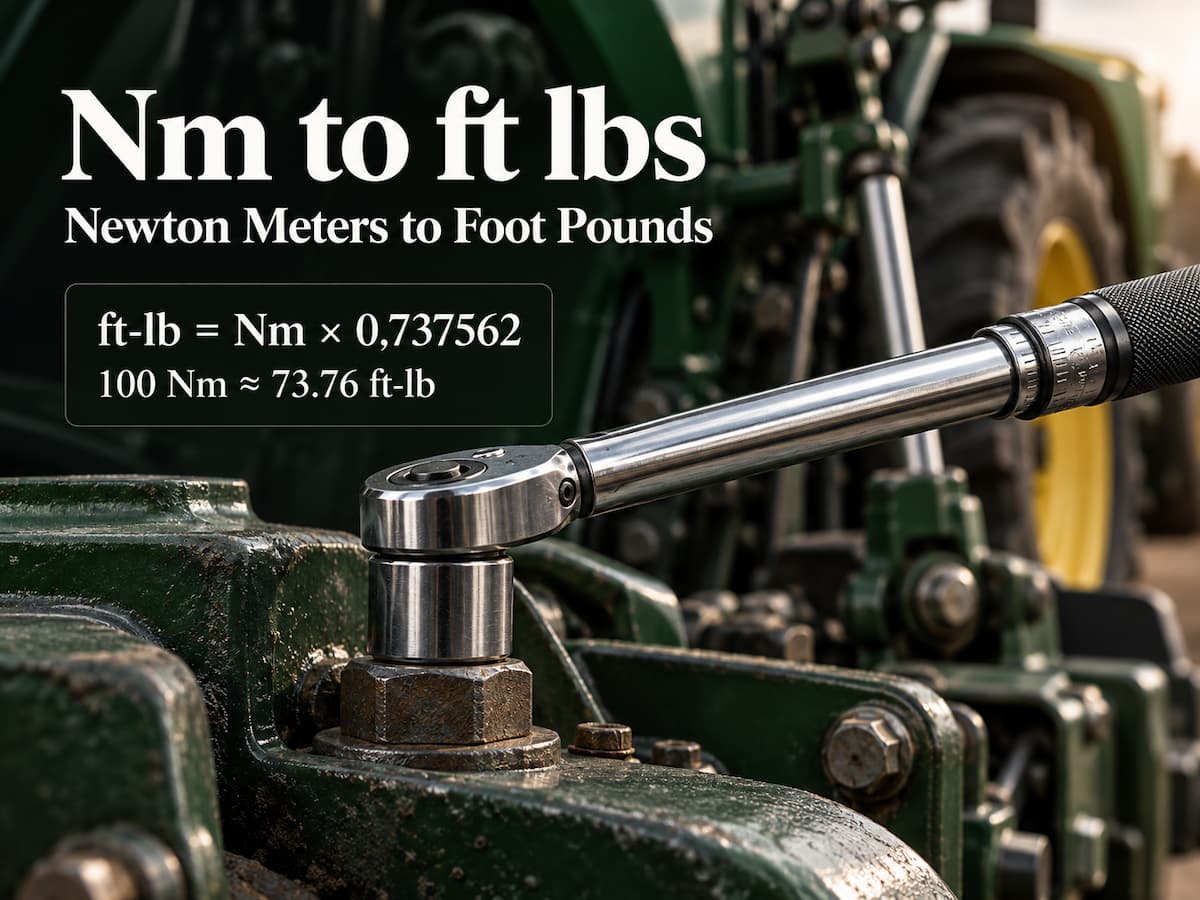
To convert Nm to ft lbs, multiply the torque in newton meters by 0.737562149. For example, 100 Nm equals approximately 73.76 ft-lb, and 1,000 Nm equals 737.56 ft-lb.
Use the calculator above when you need to compare torque specifications, read an engine rating, or convert a service manual value into the units on your torque wrench. Below, you’ll find the conversion formula, worked examples, and a table covering common torque values.
The newton meters to foot pounds conversion formula is:
Torque in ft-lb = Torque in Nm × 0.737562149
For most everyday calculations, multiplying by 0.73756 gives enough precision. Keep additional digits during the calculation, then round your final answer to suit the task.
For example, to convert 230 Nm to ft lbs:
230 × 0.737562149 = 169.63929427 ft-lb
Rounded to two decimal places, 230 Nm equals 169.64 ft-lb.
You can also divide the value in newton meters by 1.355817948 to obtain the same result. Multiplication is often easier when you need to convert several values using a spreadsheet or a handheld calculator.
For the reverse calculation, use:
Torque in Nm = Torque in ft-lb × 1.355817948
For example, 100 ft-lb equals approximately 135.58 Nm.
Check the direction before calculating. When you convert a positive torque value from Nm to ft-lb, the numerical result should be smaller. When you convert from ft-lb to Nm, it should be larger.
Use this table to look up common values without repeating the calculation. All results use the same conversion factor and rounding to two decimal places.
Newton meters (Nm)Foot-pounds (ft-lb)10.74107.385036.8810073.7610678.1813398.10170125.39230169.64280206.52340250.77360265.52370272.90520383.53640472.04650479.42746550.221,000737.561,8001,327.61
These figures represent unit conversions. To choose a tightening torque for a particular fastener, refer to the specification for that component and application.
Multiply 280 by the conversion factor:
280 × 0.737562149 = 206.52 ft-lb
A specification of 280 Nm therefore represents approximately 206.52 foot-pounds of torque.
For an engine torque figure or another specification of 746 Nm:
746 × 0.737562149 = 550.22 ft-lb
You can use this result to compare ratings when one manufacturer lists newton meters and another lists pound-feet.
Whether you write the input as “1000nm” or “1,000 Nm,” the calculation is:
1,000 × 0.737562149 = 737.56 ft-lb
Spaces and number separators do not change the quantity.
For a larger value:
1,800 × 0.737562149 = 1,327.61 ft-lb
The formula stays the same across the range. You do not need a separate conversion factor for high torque values.
Torque describes the turning effect of a force around a pivot or axis. You produce torque when you push on a wrench to turn a bolt.
For a force acting at a right angle to the lever arm:
Torque = Force × Lever arm length
One newton meter represents one newton of force acting at a perpendicular distance of one meter from the axis. The standard symbol is N·m, although manuals and online calculators often use Nm.
One pound-foot represents one pound-force acting at a perpendicular distance of one foot. For torque, lbf·ft makes the force unit explicit. You will also encounter lb-ft, ft-lb, and ft-lbs in product descriptions, workshop instructions, and search results.
When comparing specifications, confirm that both figures describe torque. Foot-pound terminology also appears in discussions of energy, where the physical quantity differs.
Searches such as “nm to ftlbs,” “nm to lbft,” “nm to ft pounds,” and “newton meters to lbs ft” generally refer to this same torque conversion.
Likewise, converting newton meters to pound feet uses the same factor as converting newton meters to foot pounds. Singular wording, such as “newton meter to foot pound,” does not change the calculation.
Some spellings need more care:
“n.m to ft lbs” usually means N·m to ft-lb.
“newton m” or “n meters” usually means newton meters in a torque context.
“nm to ft/lbs” often means ft-lb, although a slash indicates division rather than multiplication.
“mn to ft lbs” may be a typing error for Nm. Confirm the intended unit before converting.
Capitalization matters in technical notation. Lowercase nm is the symbol for nanometers, a unit of length. For torque, write N·m or the common abbreviation Nm.
Before setting your wrench, check whether its scale uses foot-pounds, inch-pounds, or newton meters. One foot-pound equals 12 inch-pounds, so confusing those scales creates a substantial error.
Round the converted result according to the wrench’s resolution and the requirements in the service instructions. A calculated result with two decimal places does not mean your wrench can measure that precisely.
Follow any specified tightening sequence, lubrication condition, or additional angle-turn instruction. A unit conversion changes how you express the torque value; you still need the correct procedure for the job.
One newton meter equals approximately 0.737562 foot-pounds.
They measure the same physical quantity when used for torque, but their unit sizes differ. 1 Nm equals approximately 0.73756 ft-lb, while 1 ft-lb equals approximately 1.35582 Nm.
Yes, for a rough estimate. Multiplying by 0.74 gives a result about 0.33% higher than using the fuller conversion factor. For specification checks, calculate with 0.737562149 and round at the end.
You need a lever arm length to calculate force from torque. Pounds-force measure force, while newton meters measure torque. To convert between torque units, use pound-feet rather than pounds alone.