Converting milligrams (mg) to milliliters (mL) may seem like a straightforward mathematical task, but there is one important detail that many people overlook: milligrams measure mass, while milliliters measure volume. Without knowing the density or concentration of a substance, an accurate conversion is impossible. An mg to mL calculator solves this problem by applying the appropriate conversion formula, helping users determine liquid volumes for laboratory experiments, pharmaceutical preparations, food measurements, and everyday applications.
Whether you are trying to understand a medication label, prepare a scientific solution, or convert the mass of a liquid ingredient into volume, knowing how these units relate can prevent costly mistakes. More importantly, understanding the calculation itself makes it easier to recognize when a conversion result is reasonable—and when it deserves a second look.
An mg to mL calculator is an online conversion tool that determines the volume of a substance in milliliters based on its mass in milligrams and its density or concentration.
Unlike conventional unit converters, which use fixed mathematical relationships, an mg to mL calculator requires additional information about the substance being measured.
For example, 1,000 milligrams of water occupies approximately 1 milliliter. However, the same mass of olive oil occupies a slightly larger volume because olive oil is less dense than water.
The difference becomes even more significant when dealing with liquid medications. A medicine labeled 100 mg/mL contains a different amount of active ingredient per milliliter than one labeled 20 mg/mL.
A reliable calculator accounts for these differences instead of assuming that every substance follows the same conversion ratio.
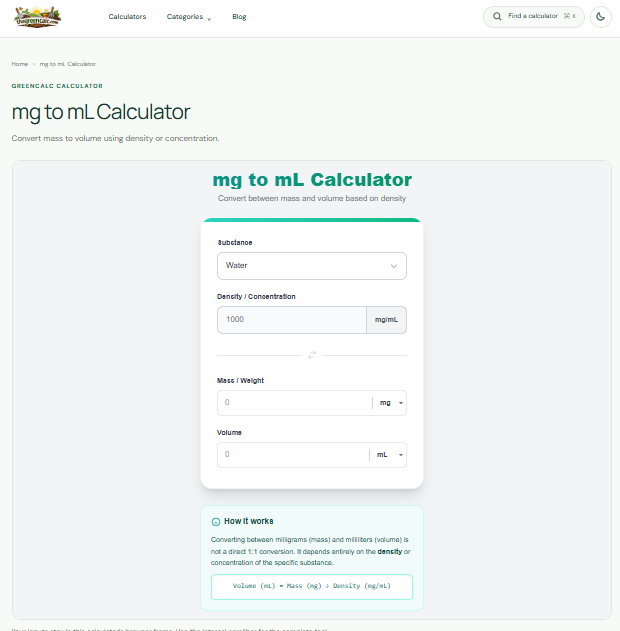
The online MG to ML Calculator by GreenCalc provides a practical way to explore these conversions using either density or concentration, depending on the substance and measurement involved.
Before using any conversion formula, it helps to understand what each unit represents.
A milligram is a metric unit of mass equal to one-thousandth of a gram.
In mathematical terms:
1 gram = 1,000 milligrams
Milligrams are commonly used to express small quantities of substances, particularly in medicine, chemistry, nutrition, and laboratory analysis.
A pharmaceutical label might state that a tablet contains 500 mg of an active ingredient. Similarly, a nutrition label might indicate that a food contains 200 mg of sodium.
In both cases, the measurement describes mass rather than volume.
A milliliter is a metric unit of volume equal to one-thousandth of a liter.
1 liter = 1,000 milliliters
Milliliters are used to measure the space occupied by liquids and other materials.
A teaspoon is conventionally equivalent to 5 mL in standardized measurements, while a small medicine cup may be marked with several milliliter measurements.
Although milliliters are often associated with liquids, volume is not limited to liquid substances.
The essential distinction is that milligrams describe how much matter is present, whereas milliliters describe how much space that matter occupies.
One of the most common misconceptions about metric measurements is that one milligram always corresponds to one milliliter.
It does not.
Mass and volume are fundamentally different physical quantities. Converting between them requires information about the substance itself.
This relationship is explained through density.
Density measures the amount of mass contained within a given volume. A substance with a higher density contains more mass per milliliter than a substance with a lower density.
Consider water and vegetable oil.
Water has a density close to 1 gram per milliliter under ordinary conditions. Many vegetable oils have densities around 0.91–0.93 grams per milliliter, depending on their composition and temperature.
Consequently, equal masses of water and vegetable oil occupy different volumes.
The same principle applies to syrups, chemical reagents, cosmetic ingredients, and numerous other materials.
For solutions containing an active ingredient, another quantity becomes essential: concentration.
Understanding which measurement to use is the foundation of every accurate mg to mL conversion.
The formula depends on whether you are converting the total mass of a substance or the mass of a particular ingredient dissolved in a solution.
When you know the mass of an entire substance and its density, use:
Volume (mL) = Mass (mg) ÷ Density (mg/mL)
If density is expressed in grams per milliliter, convert the units before calculating:
Volume (mL) = Mass (mg) ÷ [Density (g/mL) × 1,000]
For example, suppose you have 2,000 mg of a liquid with a density of 0.8 g/mL.
First, convert its density into milligrams per milliliter:
0.8 × 1,000 = 800 mg/mL
Then divide the mass by the density:
2,000 ÷ 800 = 2.5 mL
The resulting volume is 2.5 milliliters.
When calculating the volume of a solution containing a specified mass of an ingredient, use:
Volume (mL) = Ingredient Mass (mg) ÷ Concentration (mg/mL)
Suppose a liquid preparation contains 50 mg of a particular ingredient in every milliliter.
If the required ingredient quantity is 200 mg:
200 ÷ 50 = 4 mL
The corresponding solution volume is 4 milliliters.
This distinction is particularly relevant in pharmaceutical calculations, where the amount of active medication is not equivalent to the total mass of the liquid.
An online calculator simplifies conversions, but the accuracy of the answer still depends on the information entered.
The process generally involves a few straightforward steps.
Begin by determining what you are measuring.
Are you converting the total mass of water, an oil, or another liquid? Or are you calculating the volume of a solution containing a specific amount of an ingredient?
This determines whether density or concentration is required.
Enter the quantity you want to convert.
If the original value is expressed in grams, multiply it by 1,000 before entering the result.
For example:
0.75 g × 1,000 = 750 mg
Choose the appropriate conversion factor.
For an entire material, use density. For an ingredient contained in a solution, use its concentration.
If a medicine label says 250 mg per 5 mL, the concentration is:
250 ÷ 5 = 50 mg/mL
Once the required information is entered, the calculator applies the corresponding formula.
For instance, converting 500 mg of an ingredient in a solution with a concentration of 50 mg/mL gives:
500 ÷ 50 = 10 mL
Before using the calculated volume, confirm that the input units are correct.
A calculator cannot automatically recognize an incorrect product concentration or an accidentally misplaced decimal point.
For medication-related measurements, the calculated value should also be checked against the product label and the instructions provided by a qualified healthcare professional.
The answer depends entirely on the substance.
For water, 1,000 mg is approximately equal to 1 mL because water has a density close to 1,000 mg/mL.
For a liquid with a density of 800 mg/mL:
1,000 ÷ 800 = 1.25 mL
For a denser material with a density of 1,250 mg/mL:
1,000 ÷ 1,250 = 0.8 mL
All three examples begin with the same mass, yet the resulting volumes differ.
This illustrates why a universal mg-to-mL conversion chart cannot provide accurate results for every material.
Water is frequently used as a reference material because its density is approximately 1 g/mL.
Using this approximation, the formula becomes particularly simple:
Volume (mL) ≈ Mass (mg) ÷ 1,000
For example:
10 mg of water ≈ 0.01 mL
50 mg of water ≈ 0.05 mL
100 mg of water ≈ 0.1 mL
250 mg of water ≈ 0.25 mL
500 mg of water ≈ 0.5 mL
1,000 mg of water ≈ 1 mL
5,000 mg of water ≈ 5 mL
These values are useful for basic calculations and educational purposes.
However, water's density changes slightly with temperature. Precise laboratory work may require a temperature-specific density rather than the rounded value.
One of the most important applications of mass-to-volume conversion involves liquid medications.
Pharmaceutical products frequently express active ingredient quantities in milligrams, while their liquid volumes are measured in milliliters.
A product label may indicate that every 5 mL contains 250 mg of an active ingredient.
This does not mean that the total liquid weighs 250 mg. Instead, it means that 250 mg of the specified ingredient is present within 5 mL of the preparation.
To determine its concentration:
250 mg ÷ 5 mL = 50 mg/mL
If a clinician has prescribed a specific milligram amount, the mathematical relationship between that amount and the product's concentration determines the corresponding liquid volume.
Nevertheless, medication calculations require additional caution.
Products containing the same active ingredient may be supplied in different concentrations. The appropriate dose may also depend on the patient's age, weight, medical condition, prescribed regimen, and other clinical factors.
An mg to mL calculator converts a known dose into volume; it does not establish whether that dose is medically appropriate.
For actual medication administration, confirm the prescribed dose, product concentration, and measuring instructions with a pharmacist or other qualified healthcare professional.
Medication labels do not always express concentration in the same format.
Some products display a concentration directly, such as:
20 mg/mL
This means every milliliter contains 20 milligrams of the specified substance.
Other products express concentration as a ratio:
100 mg/5 mL
Here, the total ingredient mass shown is contained in 5 milliliters.
To convert that label into milligrams per milliliter:
100 ÷ 5 = 20 mg/mL
The two examples therefore represent the same concentration.
A frequent calculation error occurs when someone reads 100 mg/5 mL as though it means 100 mg/mL.
That misunderstanding would produce a fivefold difference in the calculated volume.
Reading the complete concentration statement is just as important as choosing the correct formula.
The same principles work in reverse.
If you know the volume and want to calculate the mass, multiply the volume by the relevant density or concentration.
For an entire substance:
Mass (mg) = Volume (mL) × Density (mg/mL)
For an ingredient within a solution:
Ingredient Mass (mg) = Volume (mL) × Concentration (mg/mL)
Consider a laboratory solution containing 40 mg of a dissolved substance per milliliter.
If a researcher measures 6 mL:
6 × 40 = 240 mg
That volume contains 240 mg of the ingredient.
Reverse conversions are useful when checking prepared solutions, reviewing concentration calculations, and performing quality-control measurements.
Density and concentration are closely related concepts, but they are not interchangeable.
Density describes the total mass of a material per unit of volume.
Concentration describes the quantity of a particular component within a defined quantity of a mixture or solution.
Imagine a bottle containing 100 mL of a liquid formulation.
Its total mass might be approximately 105 grams, giving it a density of about 1.05 g/mL.
However, the formulation might contain only 2 grams of a particular dissolved ingredient.
That ingredient's concentration would be:
2,000 mg ÷ 100 mL = 20 mg/mL
The density of the entire formulation and the concentration of its ingredient describe different properties.
Using the formulation's density to calculate an active ingredient's volume requirement would give an incorrect result.
A well-designed mg to mL calculator must therefore distinguish between these two types of input.
Healthcare professionals frequently work with medication concentrations and liquid volumes.
A mass-to-volume calculator may support arithmetic checks when preparing or reviewing liquid formulations.
However, clinical medication preparation and administration require validated procedures, appropriate equipment, and independent verification where applicable.
Chemists regularly prepare solutions using defined masses of reagents.
A researcher may know the required mass of a chemical but need to determine the corresponding volume of a liquid reagent.
When the reagent's density is known, the calculation becomes straightforward.
For dissolved substances, concentration-based calculations help determine the appropriate volume of a stock solution.
Food manufacturers and culinary professionals often measure ingredients by both mass and volume.
Honey, milk, edible oils, and syrups have different densities, meaning their mass-to-volume relationships are not identical.
Converting between the two units may help when adapting formulations or comparing ingredient specifications.
However, for recipes involving powders or granular ingredients, bulk density can vary according to packing and moisture content.
Cosmetic formulations may include oils, glycerin, fragrances, and other liquid ingredients.
Because these materials have different densities, converting ingredient masses into volumes requires substance-specific information.
Accurate measurements are particularly valuable when consistency between product batches matters.
Veterinary preparations may express medication strength in milligrams per milliliter.
The corresponding volume must be calculated from a veterinarian's prescribed dose and the product's verified concentration.
As in human healthcare, the calculator cannot determine the appropriate dosage on its own.
This is incorrect.
For water, approximately 1,000 mg corresponds to 1 mL—not 1 mg.
The distinction represents a factor of one thousand.
Using water's density for an unrelated liquid can produce inaccurate conversions.
Oil, alcohol, glycerin, and concentrated syrups behave differently.
Always use a density appropriate to the actual material and measurement conditions.
A concentration of 50 mg/mL describes the amount of a particular ingredient in a solution.
It does not mean the entire liquid has a density of 50 mg/mL.
Recognizing the distinction prevents a fundamental calculation error.
Milligrams and micrograms are not equivalent.
1 mg = 1,000 micrograms (mcg or µg)
Confusing these units can produce a thousandfold error, making careful verification especially important in medical and scientific settings.
A value of 0.5 mL is ten times larger than 0.05 mL.
Small differences in notation can therefore have significant consequences, particularly when measuring concentrated substances.
Even a mathematically correct answer can become inaccurate when the actual volume is measured improperly.
For oral liquid medications, a suitable graduated oral syringe or other recommended metric dosing device is generally preferable to an ordinary household spoon.
Temperature can influence density and, consequently, the relationship between mass and volume.
Many liquids expand as their temperature increases.
When the same mass occupies more space, its density decreases.
Water provides a familiar example, although its behavior near freezing is unusual compared with many other liquids.
For routine household calculations, small temperature-related differences may not be significant.
In analytical laboratories, industrial production, and other precision-sensitive environments, they may matter considerably.
A density value should ideally correspond to the temperature at which the material is being measured.
An online calculator can perform the mathematical operation precisely, but the accuracy of its output depends on the inputs.
Three factors deserve attention.
First, the density or concentration must represent the correct substance or formulation.
Second, all units must be consistent. A concentration in grams per liter cannot automatically be treated as milligrams per milliliter without checking the numerical conversion, even though 1 g/L is numerically equal to 1 mg/mL.
Third, the source measurements should be sufficiently precise for the intended application.
For example, entering a density rounded to one decimal place may be acceptable for an approximate kitchen conversion but inadequate for specialized analytical work.
It is also worth distinguishing mathematical precision from real-world measurement accuracy.
A calculator might display six decimal places, but that does not mean the original density, concentration, or measured mass is accurate to six decimal places.
For water, 100 mg is approximately equal to 0.1 mL.
For a solution with an ingredient concentration of 25 mg/mL, 100 mg of that ingredient is contained in 4 mL.
The correct answer depends on the relevant density or concentration.
For water, 250 mg corresponds to approximately 0.25 mL.
If a liquid formulation contains 50 mg of an ingredient per milliliter, 250 mg of that ingredient corresponds to 5 mL of the formulation.
For water, 500 mg is approximately 0.5 mL.
For a solution with a concentration of 100 mg/mL, 500 mg of the specified ingredient is contained in 5 mL.
Approximately, for water.
This relationship should not be generalized to medications, oils, chemical solutions, or other materials without verifying density or concentration.
If you are converting the total mass of a material into volume, you need its density.
If you are converting the mass of an ingredient into the volume of a solution, you need its concentration.
Without the relevant information, a unique conversion cannot be calculated.
No.
Milligrams indicate mass.
Milligrams per milliliter indicate mass concentration, or mass per unit volume, depending on the context.
The second quantity describes a relationship between mass and volume rather than mass alone.
Sometimes, but the appropriate method depends on the intended measurement.
A powder's bulk density can be used to estimate the volume occupied by a given mass of powder.
However, bulk density changes with particle size, moisture, and packing conditions.
If a powder is dissolved or reconstituted in a liquid, the final solution volume and resulting concentration must be determined from the preparation instructions or verified measurements. They cannot be assumed from the powder's mass alone.
Both express concentration.
A label showing 100 mg/mL indicates 100 mg of an ingredient in each milliliter.
A label showing 100 mg/5 mL indicates 100 mg in five milliliters, equivalent to 20 mg/mL.
Reading the denominator carefully is essential.
No.
A calculator can determine the liquid volume corresponding to a specified amount of medication when its concentration is known.
Determining the correct dose requires medical or veterinary judgment and appropriate prescribing information.
Differences usually arise from the conversion factors used, the assumptions about density, rounding methods, or the interpretation of concentration.
Some calculators assume water density by default. Others require users to enter a specific substance or concentration.
Comparing the input settings often explains the discrepancy.
A useful mg to mL calculator should do more than return a number.
It should clearly identify the units being entered, distinguish density from concentration, and make its underlying formula understandable.
The ability to convert in both directions is also valuable. Users may need to calculate milliliters from milligrams in one situation and milligrams from milliliters in another.
For concentration-based conversions, the tool should support common label formats such as mg/mL and mg per 5 mL.
Most importantly, it should make clear that preset density values are approximations and that medicine-related calculations require verified concentrations.
The GreenCalc MG to ML Calculator offers an accessible reference for understanding mass-to-volume conversions and exploring how different materials produce different results.
It is most useful when treated as a calculation aid rather than a substitute for checking product specifications or professional instructions.
Digital calculators save time, particularly when working with unfamiliar concentrations or converting several measurements.
Yet understanding the formula remains valuable.
A basic knowledge of mass, volume, density, and concentration makes it easier to detect implausible results.
For instance, if a small ingredient mass unexpectedly produces a very large calculated volume, the input concentration may have been entered incorrectly.
Likewise, a result that changes dramatically after switching from milligrams to micrograms deserves careful review.
The most dependable approach combines accurate source information, the appropriate mathematical relationship, and a final check of the result.
An mg to mL calculator brings these elements together, but informed use remains essential.
The relationship between milligrams and milliliters is more nuanced than it first appears. What looks like a simple unit conversion is actually a calculation built around the physical properties of a material or the concentration of an ingredient.
For water, the arithmetic is usually simple. For oils, laboratory reagents, pharmaceutical solutions, and other formulations, the details matter.
Once density and concentration are understood, the formulas become much easier to apply—and an online mg to mL calculator becomes a genuinely useful tool rather than just another number converter.
Have you ever encountered confusing mg/mL labels or inconsistent conversion results? Share your experience or questions in the comments. Your insights may help other readers avoid common measurement mistakes and better understand these essential units.