Have you ever looked at your dog and wondered how old they would be if they were human? The answer is more surprising than you might expect. Although many people believe that one dog year equals seven human years, modern research tells a different story. Dogs mature rapidly during their early years, and their aging patterns change as they grow older. A Dog Age Calculator helps you explore these differences, offering a more meaningful comparison between your pet's age and the stages of human life.
Understanding your dog's age is more than a matter of curiosity. It can help you recognize changing nutritional needs, adjust exercise routines, and prepare for the challenges of caring for an aging companion.
A Dog Age Calculator is an online tool that estimates a dog's age in human-equivalent years. Rather than relying entirely on the traditional seven-year rule, more advanced calculators consider established aging guidelines or scientific models.
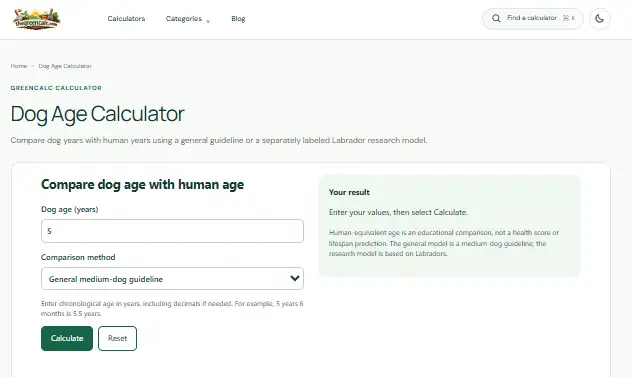
The GreenCalc Dog Age Calculator offers two distinct approaches: a general age-conversion guideline and a research-based formula developed from studies involving Labrador Retrievers.
These methods provide different perspectives on canine aging. Neither measures a dog's exact biological age, but both help explain how quickly dogs develop compared with humans.
Using the GreenCalc calculator is straightforward. Enter your dog's chronological age, choose the calculation method, and review the estimated human-age equivalent.
If your dog is five years and six months old, for example, you can enter 5.5 years.
The general calculation follows widely recognized veterinary guidelines:
A one-year-old dog is approximately equivalent to a 15-year-old human.
At two years old, the comparison reaches approximately 24 human years.
After the second year, each additional dog year adds approximately five human-equivalent years.
Under this general model, a five-year-old dog corresponds to approximately 39 human years.
These figures are estimates rather than exact biological measurements.
The familiar rule of multiplying a dog's age by seven has survived for generations. Unfortunately, it overlooks a fundamental characteristic of canine development.
Dogs grow up remarkably quickly.
A one-year-old dog may already be physically mature or approaching maturity, depending on its breed. A seven-year-old human, meanwhile, is still a child.
This difference makes a fixed multiplication formula unrealistic.
Veterinary research suggests that canine aging is particularly rapid during the first two years, followed by a more gradual progression. The pace of aging also varies among different breeds and body sizes.
That is why modern dog-age comparisons are more nuanced than a simple mathematical shortcut.
Researchers have investigated canine aging by examining changes in DNA methylation, a biological process associated with development and aging.
One influential study involving Labrador Retrievers proposed the following mathematical relationship:
Human Age = 16 × ln(Dog Age) + 31
The symbol ln represents the natural logarithm.
Using this formula, a five-year-old Labrador produces an estimated human-age equivalent of approximately 56.8 years.
Interestingly, this differs substantially from the general guideline's estimate of 39 years.
The difference does not necessarily mean one calculation is incorrect. The methods examine aging through different frameworks, and the DNA-based research was developed using Labrador data rather than every dog breed.
Absolutely. A Chihuahua and a Great Dane may celebrate their fifth birthdays on the same day, yet their expected aging patterns can be very different.
Smaller dogs generally have longer lifespans than larger breeds. Giant breeds may also enter their senior years earlier.
Genetics, body condition, inherited health risks, nutrition, and veterinary care can influence an individual dog's health throughout life.
Consequently, a human-age estimate should be viewed as a helpful comparison, not a prediction of lifespan.
Understanding your dog's life stage can make everyday care more thoughtful.
Young dogs need suitable nutrition, socialization, training, and opportunities for healthy physical development.
Adult dogs benefit from regular exercise, preventive veterinary examinations, dental care, and weight management.
Older dogs may require closer attention to mobility, vision, hearing, and changes in behavior.
A dog that suddenly becomes less active is not necessarily experiencing normal aging. Pain, illness, or another treatable condition could be responsible.
Age calculators can encourage awareness, but professional veterinary assessment remains essential.
Under GreenCalc's general guideline, a three-year-old dog is approximately 29 human years old. Different scientific models may produce other estimates.
It depends on the breed and size. Some larger dogs are considered seniors around five or six years old, while smaller breeds may reach that stage later.
No. These calculators compare aging patterns but cannot predict an individual dog's remaining lifespan.
Its general method provides a broad comparison, while the alternative DNA-based model reflects Labrador research. Neither should be treated as an exact breed-specific assessment.
A dog's age is more than a number on a calendar. It reflects years of growth, companionship, physical changes, and unforgettable moments.
The GreenCalc Dog Age Calculator offers an interesting way to explore your pet's human-age equivalent while reminding us that every dog ages differently.
Whether your companion is an energetic puppy or a gentle senior, understanding their stage of life can help you provide more appropriate care.
How old is your dog, and what human-age equivalent did you discover? Share your dog's breed, age, and results in the comments. Your experience might surprise other dog lovers!