If you operate a wheel blast machine, air blast cabinet, tumble blast machine, hanger blast machine, or any industrial surface preparation system, understanding shot blasting spare parts is one of the smartest ways to reduce downtime and maintenance costs. Many production interruptions are caused not by major machine failures, but by worn consumable components that were not inspected or replaced in time.
In this practical guide, you will learn which spare parts wear out fastest, how to inspect them, how to select quality replacements, and how to build a preventive maintenance plan that keeps production running smoothly. The article is written in a simple, friendly style and is designed for factory owners, maintenance technicians, purchasing managers, and workshop supervisors.
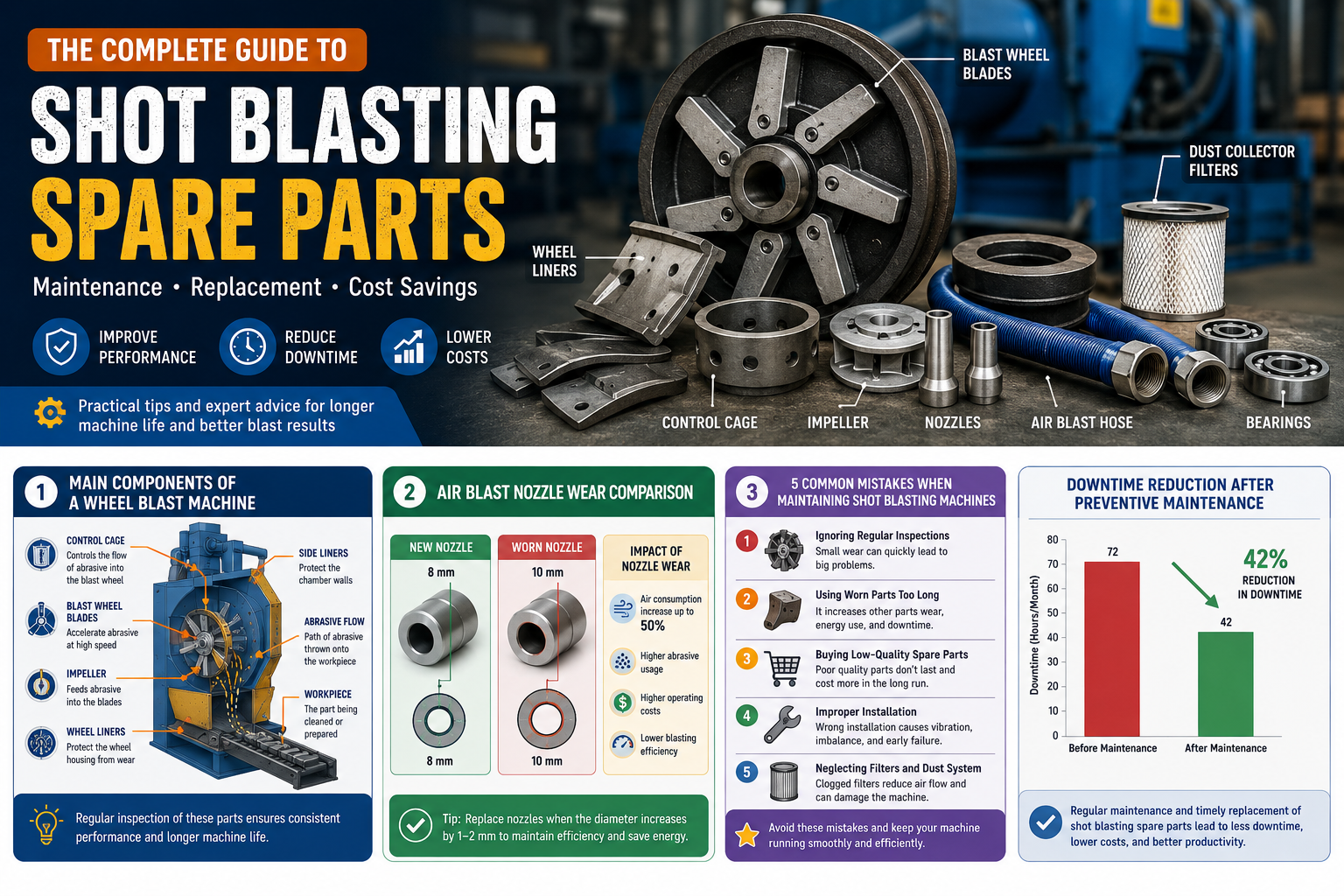
Shot blasting spare parts are the replaceable components used in shot blasting equipment, such as blast wheels, blades, control cages, liners, impellers, nozzles, hoses, filters, and bearings. Regular inspection and timely replacement of these parts can improve blasting efficiency, reduce abrasive consumption, prevent machine damage, and extend equipment life.
Shot blasting machines work in a highly abrasive environment. Steel shot, grit, or other blasting media continuously strike internal components at high velocity. Even high-quality wear-resistant parts eventually lose thickness, shape, and performance.
When worn parts remain in service too long, operators may notice:
Lower cleaning efficiency
Uneven surface finish
Higher abrasive consumption
Increased power consumption
Excessive vibration
Dust leakage
Unexpected machine stoppage
Replacing worn components at the correct time is usually far cheaper than repairing secondary damage caused by neglected maintenance.
Shot blasting spare parts include all consumable and serviceable components that can be replaced during routine maintenance.
Part
Function
Typical Wear Sign
Blast wheel blades
Accelerate abrasive
Rounded edges, reduced thickness
Control cage
Direct abrasive flow
Enlarged opening
Impeller
Feed abrasive to blades
Erosion grooves
Wheel liners
Protect housing
Thin spots or cracks
Side liners
Protect chamber walls
Excessive wear
Blast nozzles
Direct air/media stream
Increased nozzle diameter
Rubber hoses
Carry abrasive
Soft spots, leaks
Dust collector filters
Remove dust
High differential pressure
Bearings
Support rotating parts
Noise, heat, vibration
Seals and gaskets
Prevent leakage
Dust leakage
These components are the heart of any shot blasting spare parts inventory.
These machines use a rotating blast wheel to throw abrasive at high speed. Their most critical spare parts are blades, impellers, control cages, and liners.
These systems use compressed air to propel abrasive through a nozzle. Their key spare parts are nozzles, hoses, couplings, valves, and air treatment components.
Knowing which system you operate helps you stock the correct shot blasting spare parts.
Blades experience the highest impact. As they wear, blasting intensity decreases.
A steel fabrication plant replaced blades every 1,200 operating hours. After introducing monthly thickness measurements, the team discovered that blades on one wheel wore 30% faster because abrasive flow was not centered. Adjusting the control cage restored uniform wear and reduced spare part consumption.
Measure blade thickness
Check leading edge rounding
Look for cracks
Replace blades as a complete set when possible
The control cage determines where abrasive enters the blast wheel. A worn opening changes the blast pattern and may cause uneven cleaning.
Enlarged opening
Irregular blast pattern
Excessive wear on one side of the machine
The impeller feeds abrasive into the rotating blades. Deep grooves or erosion reduce abrasive flow and blasting efficiency.
Liners protect the blast chamber from direct abrasive impact.
Remaining thickness is below the manufacturer limit
Cracks appear
Fasteners become exposed
Abrasive begins attacking the machine body
In air blast systems, nozzle wear is often underestimated. A nozzle that has worn from 8 mm to 10 mm can dramatically increase air consumption.
New nozzle: 8 mm
Worn nozzle: 10 mm
Air consumption increase: often more than 50%
Replacing a relatively inexpensive nozzle can save significant compressor energy.
Keeping every possible part in stock is expensive. A better approach is to classify parts by criticality.
Blast wheel blades
Control cages
Impellers
Nozzles
Hoses
Filters
Bearings
Liners
Seals
Gaskets
Valves
Structural covers
External guards
Non-wear hardware
A well-organized shot blasting spare parts inventory reduces emergency purchasing and production delays.
Check abrasive level
Inspect hoses and visible liners
Listen for unusual noise
Empty dust collector bins
Inspect blades and control cages
Check filter differential pressure
Inspect seals for leakage
Measure wear part thickness
Check bearing temperature
Verify wheel alignment
Inspect electrical connections
Replace heavily worn wear parts
Inspect impeller and wheel housing
Calibrate abrasive flow
Major machine inspection
Bearing replacement if recommended
Structural inspection of blast chamber
Using a maintenance schedule is one of the most effective ways to extend the life of shot blasting spare parts.
Not all spare parts perform the same. Poor-quality components may fail quickly and increase overall operating cost.
Material grade
Hardness range
Heat treatment process
Dimensional tolerances
Compatibility with your machine model
Warranty terms
Request technical drawings or part numbers before ordering. Small dimensional differences can affect wheel balance and performance.
Guaranteed compatibility
Manufacturer support
Consistent quality
Higher price
Longer delivery time in some regions
Lower cost
Faster local availability
Quality varies by supplier
A reliable aftermarket supplier can provide excellent value, especially for frequently replaced shot blasting spare parts.
Possible causes
Worn control cage
Uneven blade wear
Incorrect abrasive flow
Action
Inspect control cage opening and replace worn blades.
Possible causes
Broken blade
Imbalanced wheel
Bearing failure
Action
Stop the machine immediately and inspect rotating components.
Possible causes
Worn liners
Abrasive leakage
Incorrect media size
Action
Inspect liners and seals, then verify abrasive specification.
Possible causes
Damaged seals
Saturated filters
Loose duct connections
Action
Replace seals and filters and tighten connections.
A workshop blasting structural steel beams experienced frequent downtime. Investigation showed:
Blades were replaced individually
Control cages were not inspected
Filter cleaning intervals were irregular
Replace blades as matched sets
Inspect control cages weekly
Introduce filter pressure monitoring
Downtime reduced by 42%
Abrasive consumption reduced by 18%
Surface quality complaints nearly eliminated
This example shows how systematic management of shot blasting spare parts directly improves productivity.
Worn components often increase power demand.
<pre><code>New nozzle (8 mm) -> Normal air use Worn nozzle (10 mm)-> High air use Worn blades -> Longer blasting time Dirty filters -> Higher fan power Misaligned wheel -> Lower efficiency </code></pre>
Replacing wear parts on time can reduce both compressed air and electrical energy costs.
Never treat spare part replacement as a simple mechanical task.
Isolate electrical power
Lock out rotating equipment
Release compressed air pressure
Wear eye and hand protection
Use lifting equipment for heavy wheel assemblies
Follow manufacturer torque values
Safety should be part of every shot blasting machine maintenance procedure.
Actual values vary by machine size and operating hours, but many plants allocate an annual wear-parts budget equal to a small percentage of machine replacement value. Tracking consumption per operating hour is more useful than tracking total annual spending.
Spare parts cost per blasting hour = Total spare parts cost / Total operating hours
Monitoring this KPI helps identify abnormal wear patterns early.
Modern factories increasingly use simple digital tools to manage shot blasting spare parts.
QR codes on machines linking to spare part lists
Spreadsheet or CMMS maintenance logs
Photo records of wear inspections
Automatic reminders for filter replacement
Stock alerts for critical components
You do not need an expensive Industry 4.0 system to gain significant maintenance benefits.
It depends on abrasive type, operating hours, and machine settings. Inspect weekly and replace when thickness reaches the manufacturer limit.
It is generally better to replace blades as a matched set to maintain wheel balance.
Usually the nozzle, especially when blasting with aggressive abrasives.
Yes, if they come from a reputable supplier and match the machine specifications.
Common causes include worn liners, abrasive leakage, incorrect media size, or damaged control cages.
Managing shot blasting spare parts is not just a maintenance task—it is a production strategy. Plants that inspect wear parts regularly, stock critical components, and replace parts before failure usually experience lower downtime, better surface quality, lower energy consumption, and longer equipment life.
Start with a simple weekly inspection routine, keep records of wear measurements, and build a small but reliable inventory of critical spare parts. These straightforward actions can deliver surprisingly large savings and make your shot blasting operation more dependable, efficient, and profitable in 2026 and beyond.
In short: the best time to think about shot blasting spare parts is before a machine stops, not after production has already been interrupted.
Source: https://shotblastengineering.com/product-category/shot-blast-spare-parts