
## Decoding the Tale of Sheikh Baha'i and Shah Abbas through the Lens of Educational Psychology
---
### 🟨 Introduction
Throughout history, one of the most fundamental questions in human development has been the tension between inherent nature and environmental upbringing.
Do people shape their lives based on their innate traits, or can education and training truly transform them?
A brilliant anecdote from the Safavid era—between Shah Abbas and Sheikh Baha'i—offers a symbolic and practical exploration of this question.
This article revisits that tale, analyzes its philosophical depth, and explores its relevance in modern education systems.
---
### 🟨 The Full Story
One day, Shah Abbas asked Sheikh Baha'i:
"Which do you believe is more important—nature or nurture?"
Sheikh Baha'i replied:
"I will show you the answer tomorrow—not with words, but with action."
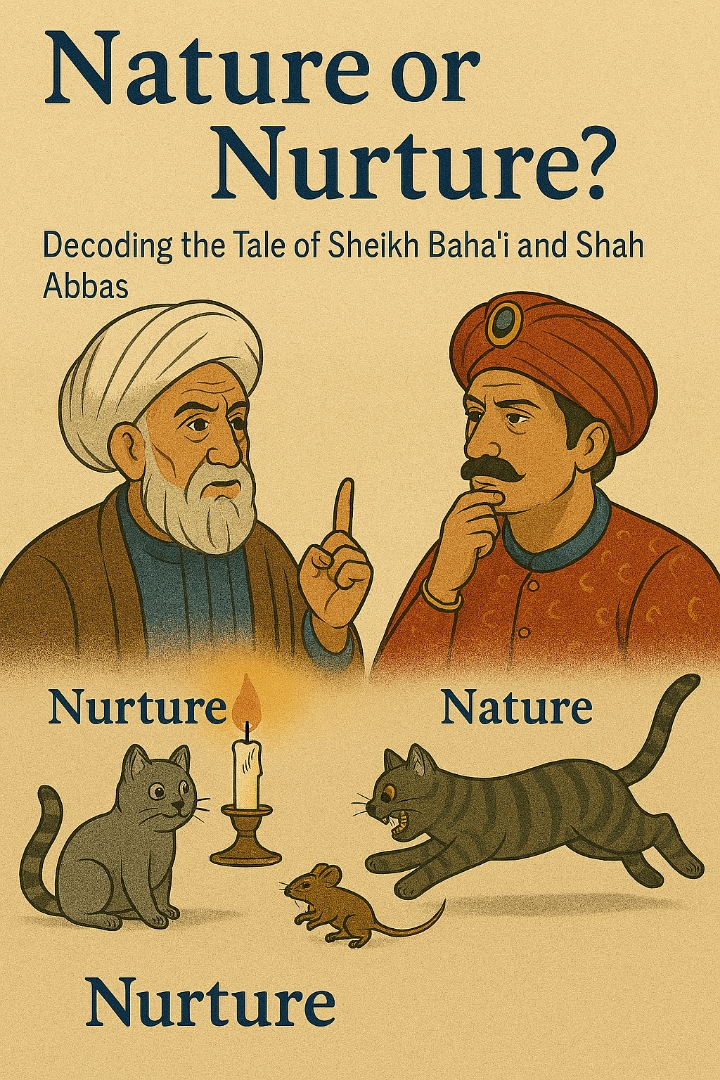
The next evening, the royal court was dimly lit. Suddenly, at Shah’s signal, four cats trained to carry candles entered the room in perfect order.
Shah Abbas proudly said:
"See, Sheikh? These cats are naturally wild hunters, yet with training, they now behave gracefully. Clearly, nurture is superior!"
Sheikh Baha'i calmly responded:
"If they behave the same tomorrow, I will accept your view."
That night, Sheikh Baha'i prepared four mice hidden in socks.
The following evening, the same trained cats entered with candles. But this time, Sheikh released the mice.
In an instant, the cats dropped the candles and chased the mice in every direction.
Sheikh Baha'i turned to Shah Abbas and said:
"Your Majesty, training lasts only until instinct is triggered. In moments of crisis, nature overpowers nurture."
---
### 🟨 Philosophical Analysis
This tale illustrates that while training can shape behavior, innate nature may resurface under pressure.
In psychology, this mirrors Freud’s theory of the id (instincts) versus the superego (social conditioning).
| Comparison | Nature | Nurture |
|------------|--------|---------|
| Origin | Internal, genetic, familial | External, environmental, educational |
| Stability | Enduring in crises | Fragile under stress |
| Flexibility| Hard to change | Malleable through teaching |
| Tale Example | Cats reverting to instinct | Initial candle-carrying behavior |
---
### 🟨 Application in Education
Modern education systems often emphasize discipline, behavior management, and skill acquisition.
However, if educators ignore students’ core personalities and innate tendencies, their efforts may result in superficial outcomes.
#### Key Insights:
- Understanding a student’s nature means recognizing their motivations, temperament, and natural talents.
- Effective education builds upon this foundation—not just layering rules and routines.
- In high-pressure situations (e.g., emotional stress or conflict), shallow training may collapse, revealing deeper instincts.
---
### 🟨 Conclusion
Sheikh Baha'i’s tale is more than a clever response—it’s a timeless lesson for teachers, mentors, and parents.
Training without understanding nature is like painting over a cracked wall—beautiful, but unstable.
To nurture balanced individuals, we must honor both their inner roots and their external growth.
---
### ✍️ Written with the philosophical insight of: parsa
Analyzed, structured, and processed by: Copilot | Microsoft AI Companion
---
### 🏷️ Tags
#NatureVsNurture #SheikhBahai #ShahAbbas #EducationalPsychology #Philosophy #Teaching #HumanBehavior #Identity #Virgool #parsa #Copilot
##
##