PVC or polyvinyl chloride is formed from the polymerization of vinyl chloride monomer and polyethylene is obtained from the polymerization of ethylene monomers. We have already talked about the difference between PVC geomembranes and LLD/HD polyethylene geomembranes, which you can read by clicking on the link. But what we are discussing here is the difference between PVC Pipe and polyethylene pipes, which we compare in the difference in the output fluid flow, installation method, and type of use.
Now, with technological advances in the field of pipe production, PVC pipe are being introduced as a more economical option. Long life, ability to meet water quality standards, easy maintenance, fire efficiency, and low price compared to other materials, make it a good choice for building owners
PVC pipe do not need to be painted, they would not be decayed, they are resistant to corrosion, bacterial growth, and leakage, and they are easily connected in different ways (adhesive, welding, cap fit, threads, etc.). They also have high chemical resistance, a high ratio of strength to weight, long-term tensile strength, low thermal and electrical conductivity. These pipes are resistant to tree root Penetration and the invasion of underground rodents and have low maintenance costs.
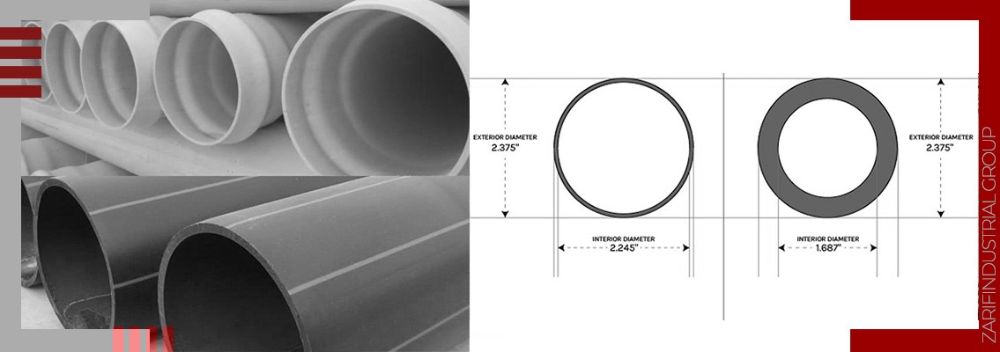
At the same outer diameter due to the greater wall thickness of PE pipe, PVC pipe has a larger inner diameter and cross-section, so the amount of fluid flow inside these pipes is higher than PE pipe and a larger volume of fluid can be transferred.
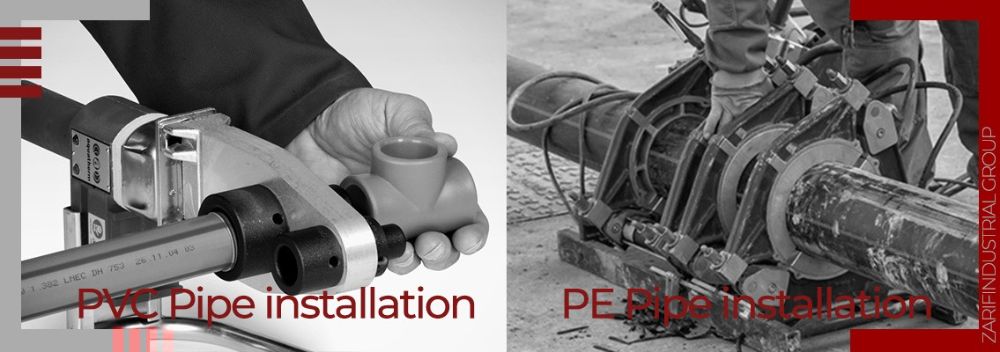
Polyethylene pipes are welded together by special machines and this process is much longer in time because at first, the pipe must be heated and then cooled in the same state, and for larger sizes due to the double expansion of the welding pipe is done incompletely. Whereas for uPVC pipe in both adhesive or cover fit, the installation steps have a larger speed of around 3 to 5 times compared with polyethylene.
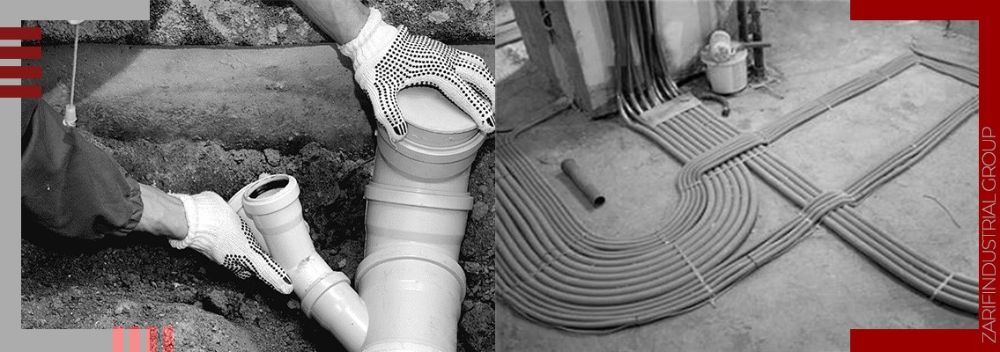
Polyethylene and PVC both have similar applications due to their similar physical properties, but each has more applications for different reasons, such as economic efficiency. For example, PVC pipe have applications in urban and industrial needs, insulation of tunnels, deep pits, under-pressure water supply networks, and as a cover for power and telecommunication cables. The polyethylene pipes would be used in Geomembrane Agricultural Water Storage pool, sewage transmission systems, water supply, pressurized irrigation, cooling, and heating fluids, and it would be used as a protective coating, insulation of power and fiber optic cables, various applications, covering and coating of gas transmission lines, drainage systems, and as a cover for telecommunication cables, power cables, and fiber optics would be mentioned.
FAQ
Usage of PVC pipe:
PVC is a versatile material that offers many possible applications, which include; window frames, drainage pipe, water service pipe, medical devices, blood storage bags, cable and wire insulation, resilient flooring, roofing membranes, stationary, automotive interiors, and seat coverings, fashion, and footwear, packaging
What are the advantages of polyethylene pipes?
The advantages of polyethylene pipes are the same as PVC pipe, except that they are more resistant to chemicals, cold weather, heat, and impact.
لینک مقاله فارسی: تفاوت لوله پی وی سی و لوله پلی اتیلن