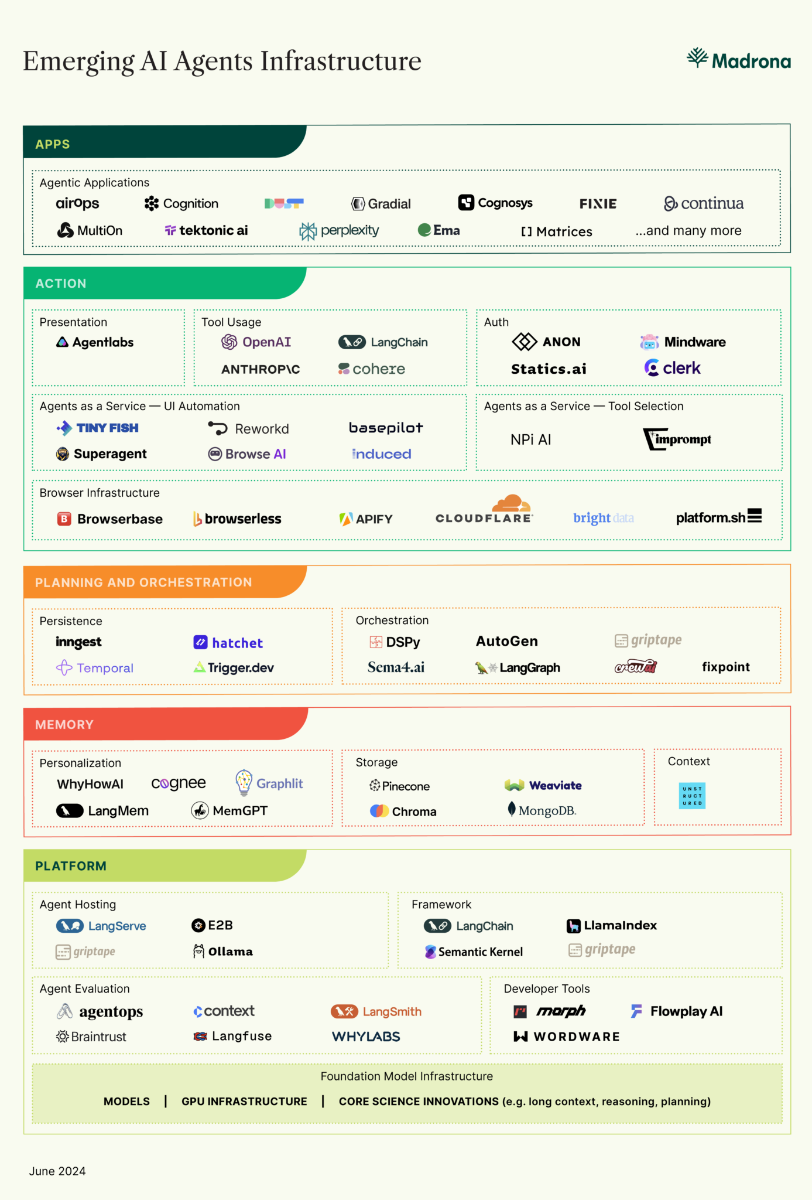
An AI agent infrastructure refers to the underlying system that supports the development, deployment, and management of AI agents. This infrastructure typically includes various components such as:
Data storage and management: This involves storing and managing large volumes of data that AI agents use for training and making predictions.
Computational resources: AI agents require powerful computational resources such as GPUs and CPUs to process data and perform complex calculations.
AI frameworks and libraries: These are software tools and libraries that provide pre-built functions and algorithms for developing AI agents. Examples include TensorFlow, PyTorch, and Scikit-learn.
Deployment and integration: Once an AI agent is developed, it needs to be deployed and integrated with other systems such as databases, APIs, and web applications.
Monitoring and management: AI agents need to be monitored and managed to ensure they are performing as expected and to identify any issues that may arise.
Overall, an effective AI agent infrastructure enables organizations to develop, deploy, and manage AI agents quickly, efficiently.