
Black hole is a great amount of matter packed into a very small area -think of a star ten times more massive than the Sun squeezed into a sphere approximately the diameter of New York City. the result is a gravitational field so strong that nothing, not even light, can escape.
In recent years, NASA instruments have painted a new picture of these strange objects that are, to many, the most fascinating objects in space. the idea of an object in space so massive and dense that light could not escape it has been around for centuries.
Most famously, black holes were predicted by Einstein's theory of general relativity, which showed that when a massive star dies, it leaves behind a small, dense remnant core. If the core's mass is more than about three times the mass of the Sun, the equations showed, the force of gravity overwhelms all other forces and produces a black hole.
Scientists can't directly observe black holes with telescopes that detect x-rays, light, or other forms of electromagnetic radiation. we can, however, infer the presence of black holes and study them by detecting their effect on other matter nearby.
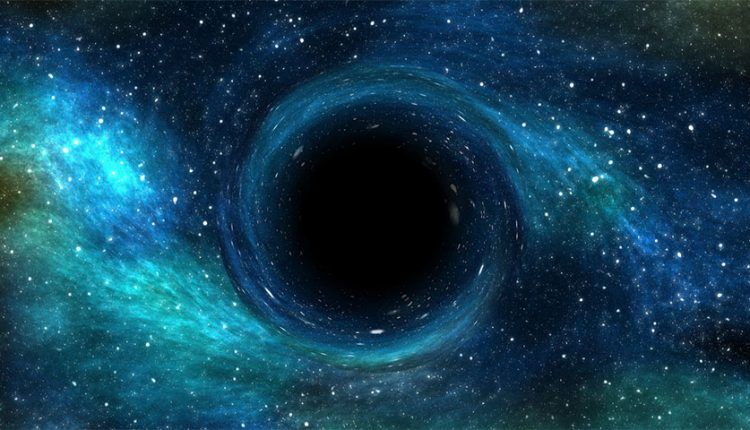
One Star's End is a Black Hole's Beginning
Most black holes form from the remnants of a large star that dies in a supernova explosion.
If the total mass of the star is large enough , it can be proven theoretically that no force can keep the star from collapsing under the influence of gravity.
Even bigger black holes can result from stellar collisions.
At the center of a black hole, it is often postulated there is something called a gravitational singularity, or singularity. This is where gravity and density are infinite and space-time extends into infinity. just what the physics is like at this point in the black hole no-one can say for sure.
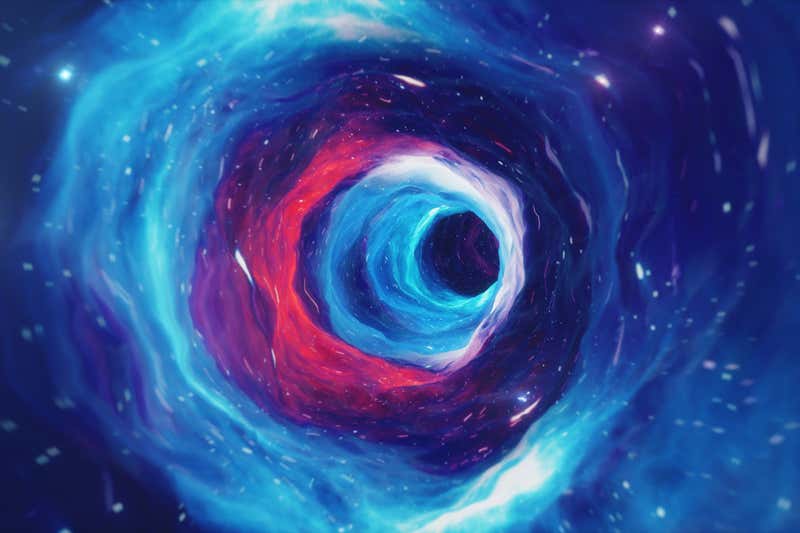
The closest black holes yet discovered to Earth are several thousand light-years away from us. At this distance, these black holes will have no discernable effect on our planet or its environment.
To date, the nearest black hole, called V616 Monocerotosis, is 3,000 light-years away and has a mass around 9-13 times that of our Sun.
How long is a piece of string? How many grains of sand are there on a beach? How many stars are there in the Galaxy? These questions are nigh on impossible to answer.
The same is true for the number of black holes in the Universe, as it has been postulated that there are so many you couldn't ever hope to count them.
Even if we tried, we would never get the right answer as a large part of the Universe will be obscured from our view, forever. If such an attempt was made we would first need to limit our count to what is more correctly called the "Observable Universe".
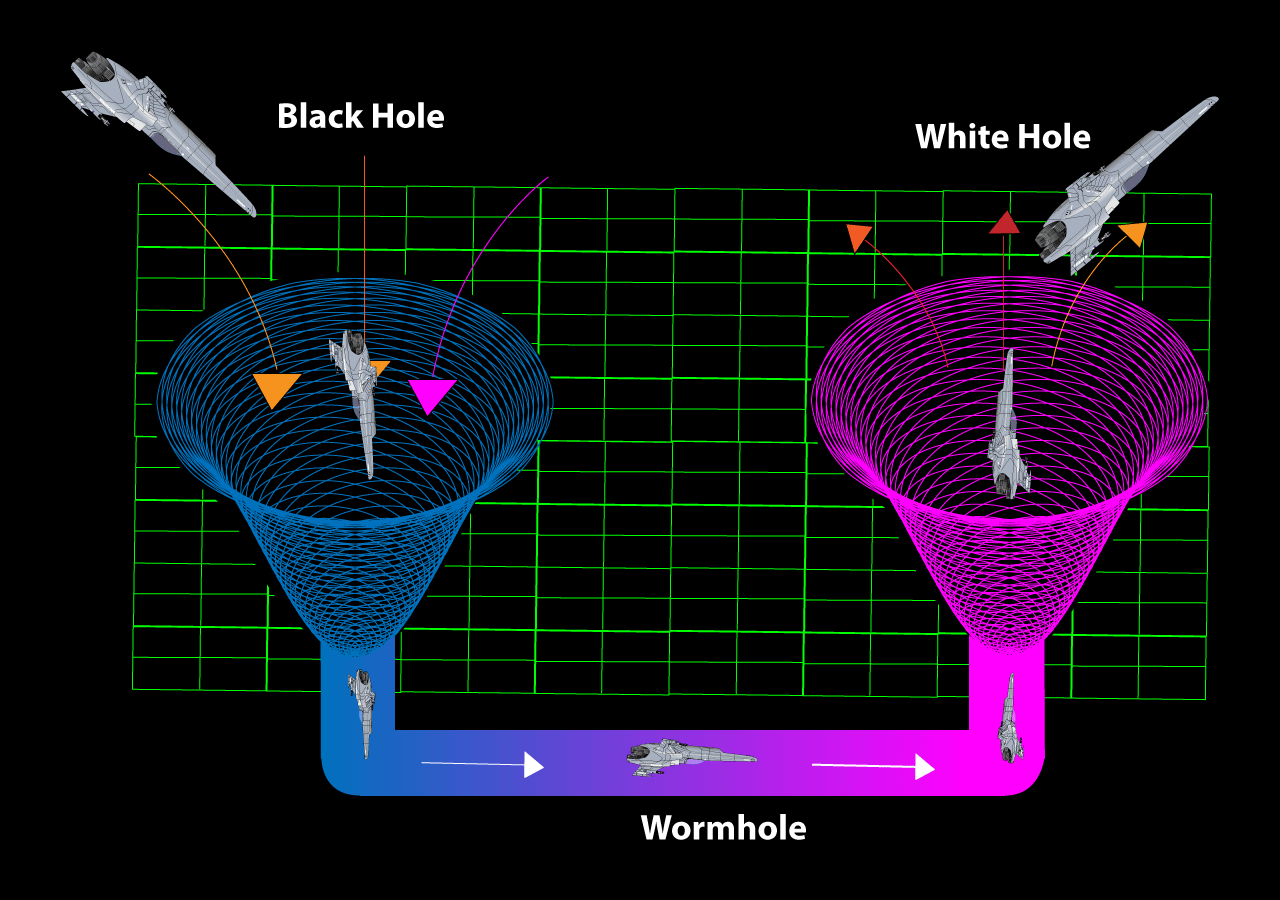
Teleportation and travelling forwards through time may be possible through wormholes, the bipolar black holes that link different regions of the universe. This is the conclusion drawn from a model created by Kyriakos Papadodimas of CERN and Rik van Breukelen of the University of Geneva.
It is, however, “a purely theoretical model that would only apply to an elementary particle, such as a photon”, adds van Breukelen.
“Wormholes are today still only theories”, says van Breukelen. “But, in principal, it would be possible to create an artificial black hole, by using a particle accelerator, for example, although it would have to be a billion kilometres long, the same distance the Earth travels around the sun in a year. so it’s an idea that’s theoretically possible, but also many millennia ahead of its time”.
Questions
a) Answer the following questions:
1) What is a black hole?
2) What do black holes form from?
3) What is at the center of a black hole?
b) Complete the sentences with the words in the text.
1) Travelling forwards through time may be possible through ...................
2) Most famously, black holes were predicted by…………….
c) True or False
1) time runs slower wherever gravity is strongest.
2) The closest black hole to earth will have discernable effect on our planet.